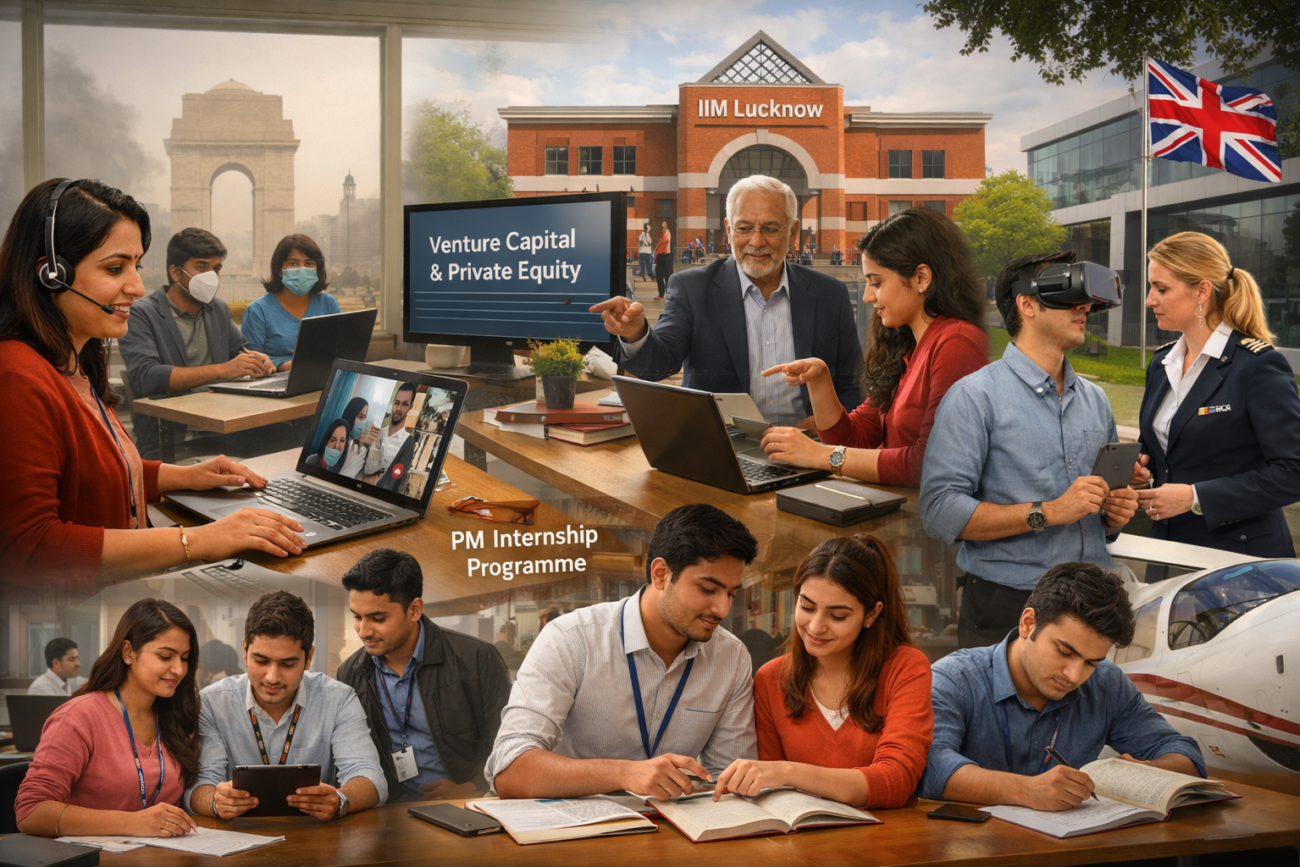
India’s education sector is undergoing rapid transformation in early 2026, driven by policy reforms and technological integration amid environmental challenges. Recent announcements highlight hybrid learning mandates in pollution-hit regions like Delhi NCR, where schools shift to blended models under GRAP Stages 3 and 4 to safeguard student health while ensuring continuity. Concurrently, elite institutions such as IIM Lucknow have launched specialized programs in venture capital and private equity with partners like Emeritus, targeting the booming $232 billion VCPE market projected by 2030. These initiatives reflect a broader push under Digital India to equip youth with future-ready skills in finance and innovation.
Government schemes like the PM Internship Programme are gaining momentum, aiming to engage 1.25 lakh individuals aged 21-24 with ₹5,000 monthly stipends across 500 top companies. This aligns with skill development priorities, including IIT Madras collaborations for data center upskilling and aviation training with ENAC France, fostering employability in STEM fields. Exam cycles dominate headlines too: UGC NET December 2025 sessions continue, JEE Main 2026 registrations loom, and CBSE board exams are set for February-April, underscoring the relentless academic calendar. Such efforts address youth unemployment by linking education directly to industry demands.
Technological advancements are reshaping classrooms globally, with tools like Google’s Gemini enhancements at Bett 2026 offering AI-driven SAT practice and connected classrooms to boost teaching efficacy. In India, this dovetails with New Zealand-India FTA provisions granting 1,667 skilled worker visas yearly for educators, engineers, and more, signaling international recognition of Indian talent pipelines. UK universities like Southampton establishing campuses here further internationalize higher education, promising diverse curricula and global exposure.
Challenges persist, particularly around air quality and access. Delhi’s hybrid orders exemplify adaptive measures, but implementation strains under-resourced schools, prompting calls for better infrastructure funding. Meanwhile, programs like IIT Madras’s NIPTA employability test and SSC verifications aim to standardize assessments, ensuring merit-based opportunities amid rising competition.
On the international front, UK Parliament’s January 19 education questions highlighted vocational training and equity, themes resonant in India’s context as leaders like Bridget Phillipson address similar gaps. These dialogues underscore a global shift toward empathetic, tech-enabled learning that prioritizes mental health and deep comprehension over rote metrics.
Looking ahead, 2026 promises intensified focus on AI ethics in education and sustainable models, with school assemblies buzzing over these updates to inspire young minds. As India balances tradition with innovation, these developments position education as the cornerstone of national progress.
